Maintaining Europe's position as a global aviation leader means modernising the air traffic management system that connects its aircraft, airports and airlines.
Europe's aviation sector is a global leader in aircraft manufacturing, avionics, airlines and airport operations. But maintaining that position increasingly depends on something less visible: the air traffic management (ATM) system that connects them all.
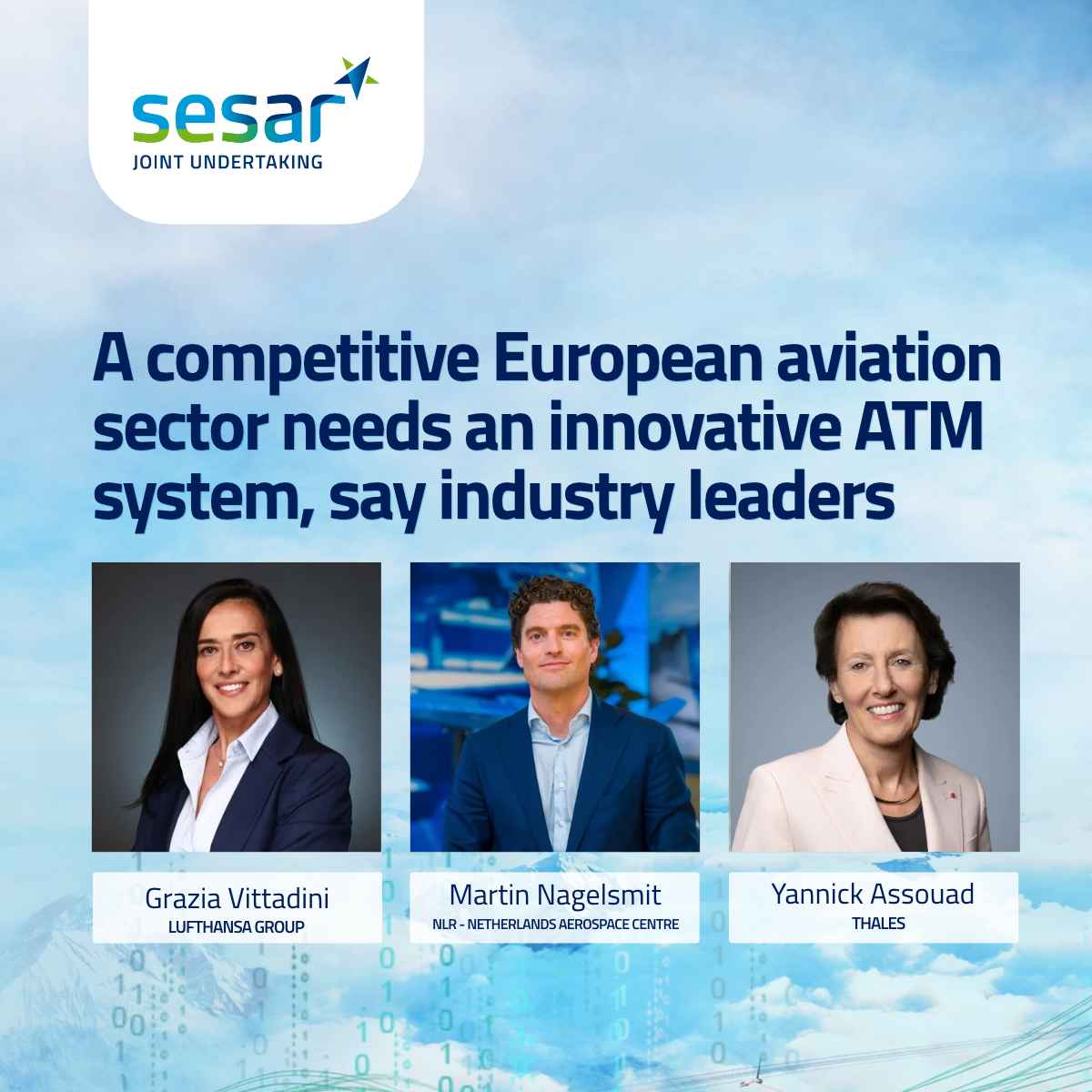
How can innovation help Europe build a more integrated, efficient and resilient airspace? We spoke to three leaders of aviation from the SESAR JU membership: Yannick Assouad, Executive Vice-President, Avionics and Executive Committee Member at Thales; Grazia Vittadini, Chief Technology Officer at Lufthansa Group; and Martin Nagelsmit, Chief Technology Officer at NLR - Netherlands Aerospace Centre, to explore why modernising Europe's ATM system is essential to the future competitiveness, sustainability and resilience of aviation.
Connecting Europe’s skies
Aviation works best when it is connected by a seamless ATM system.
And that isn’t always the case.
“Because Europe’s ATM landscape is fragmented across different national systems and procedures, airlines can face unnecessary complexity when navigating European airspace,” says Yannick Assouad, Executive Vice-President, Avionics & Executive Committee Member, Thales.
A more integrated European airspace would help address this fragmentation, allowing aircraft to follow more direct routes, make better use of available capacity and improve coordination across national borders. The result would be fewer delays, more reliable journeys and a stronger aviation network connecting people, businesses and regions across Europe.
“Europe must modernise its ATM system and ensure it evolves alongside the rest of the aviation sector,” adds Assouad.
The key to doing so is innovation.
By enabling airlines, airports and air navigation service providers to share accurate, real-time information, innovative ATM technologies can help the entire aviation ecosystem proactively anticipate problems rather than simply react to them.
Making aviation smarter, more efficient and sustainable
Consider, for example, the impact a delayed aircraft or unexpected bad weather can have. Without the timely sharing of information, such disruptions can quickly cascade across the network, affecting connecting flights, airport operations and passengers. With better data exchange and predictive capabilities, stakeholders can identify potential bottlenecks earlier and adapt operations accordingly.
Automation and artificial intelligence (AI) offer additional opportunities, helping to process routine information, improve traffic forecasts and support decision-making.
However, using AI in ATM isn't without its challenges. As the panellists emphasised, these technologies must be verifiable, predictable and explainable before they can be trusted in safety-critical operations.
“Innovation isn’t about replacing the human expertise that is at the heart of ATM,” says Martin Nagelsmit, Chief Technology Officer at NLR. “It is about equipping people with better information and capabilities to make more informed decisions.”
There is also a significant environmental dimension to innovation: more efficient flight paths, reduced holding patterns and better use of airspace can all help minimise unnecessary flying distances, fuel consumption and carbon emissions.
“Europe has made important commitments to improving efficiency and decarbonising aviation,” comments Assouad. “Innovation in air traffic management is essential to delivering on those commitments.”
From digital aircraft to digital skies
Innovation in ATM isn’t theoretical.
It’s already happening.
Lufthansa Group, for instance, is retrofitting 134 existing Airbus A320 aircraft with technology that allows them to automatically share predicted flight paths and timing with air traffic control. By 2028, the technology will be in service on nearly 200 Lufthansa Group A320-family aircraft.
This is an important step towards a more connected aviation ecosystem. “Connectivity starts with airlines, airports and air traffic control sharing an up-to-date picture of each flight. This can help improve traffic planning and coordination,” explains Grazia Vittadini, Chief Technology Officer at Lufthansa Group.
But as Vittadini stresses, realising these benefits depends on the wider ATM infrastructure being able to use that shared picture. “A digital aircraft needs a digital system around it,” she says.
This illustrates a wider point: the benefits of innovation cannot be realised in isolation. Progress depends on connecting technologies, systems and stakeholders across the entire aviation ecosystem.
Building a more resilient and sovereign Europe
Efficiency is only part of the innovation equation.
With geopolitical tensions, extreme weather and technical failures all capable of disrupting aviation, ATM innovation is also critical to Europe's resilience. “Resilience means ensuring that our airspace can continue operating safely when things go wrong,” says Vittadini.
Achieving such resilience requires interoperable systems, built-in redundancy and alternative capabilities that can be deployed when disruptions occur. It also means addressing the security challenges that accompany greater digitalisation.
“As more aviation systems become interconnected and increasingly reliant on data exchange, cybersecurity must be built into their design from the outset,” explains Assouad.
But resilience isn't just about keeping aircraft moving during disruptions. It's also about ensuring Europe has the technologies, expertise and alternatives needed to maintain control over its own aviation infrastructure – an important part of Europe's technological sovereignty.
“ATM is critical infrastructure for Europe,” remarks Vittadini. “Open interfaces and credible technological alternatives can help Europe retain its ability to operate its systems and make meaningful choices about its future.”
Putting innovation to work
The good news is that Europe isn't starting from scratch. Through the SESAR JU, researchers and industry partners have already developed and tested many of the innovative technologies and operational concepts needed to make the Digital European Sky a reality.
The challenge now is accelerating their adoption.
“Innovation can only deliver its full potential when solutions move beyond research and demonstration and into everyday operations,” says Nagelsmit. “This requires continued investment, but also large-scale demonstrations that prove these solutions can work across the entire European aviation network.”
The need to sustain this research and innovation effort is also reflected in the European Commission's proposal for a Smart and Clean Aviation moonshot under the next Multiannual Financial Framework (MFF) for 2028–2034. The moonshot recognises the importance of developing the next generation of CO₂-free aircraft and automated air traffic management systems, providing a framework for continued investment in aviation innovation. It also highlights the importance of carrying forward the work undertaken through SESAR, ensuring a clear pathway from research and demonstration through to industrial development and operational deployment.
For Vittadini, this requires industry and public authorities to continue working together, bringing investment, expertise and commitment to the modernisation of Europe's aviation system. As she put it: “Europe leads when we invest together and put innovation to work.”
Assouad also underlines the importance of maintaining a strong public-private partnership to accelerate innovation in ATM, given the long-term nature of research and development.
“The public-private partnership is so key to invest and go faster,” she says. “So I really think that it needs to be kept. It needs to be correctly funded. And that's why the MFF, the future Multiannual Financial Framework, is key for Europe,” she concludes.
Watch the full interviews and the panel discussion from the SESAR JU annual conference