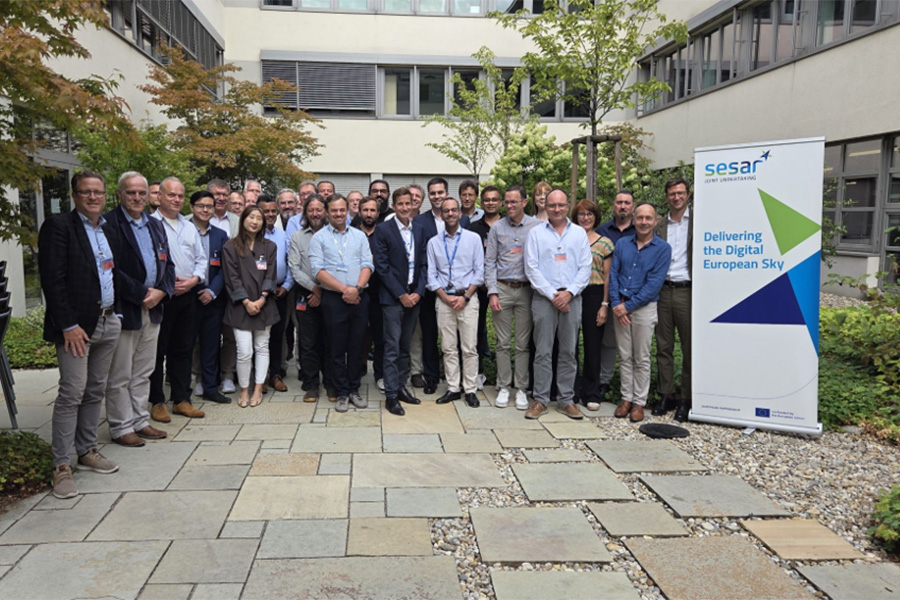
How can air traffic services become more flexible, scalable and resilient in an increasingly connected aviation system? This is a question being addressed by several SESAR JU research projects exploring the new service delivery model. Among them is NATICA, led by Frequentis, which will develop and validate a platform for air traffic services.
Building on previous SESAR research
The work builds on several years of SESAR research into the virtualisation of air traffic services and the new service delivery model, in line with Strategic Deployment Objectives 6 and 8 of the European ATM Master Plan. Earlier initiatives, including the EXODUS and DEVICE Digital Sky Demonstrators and the iSNAP research project, have explored how air traffic services can be decoupled from local infrastructure, enabling virtual centres, greater flexibility in service provision and interoperability between different providers. Building on these foundations, a new wave of industrial research projects - including HAVEN, ARTEMISA, NATICA, ATMOSPHER and NOMAD - is taking this work further, developing more modular, open and cloud-based platforms that make it easier to integrate, upgrade and share services and applications. Led by different technology providers, Thales, Indra, Frequentis, Leonardo and Tern Systems respectively, these projects are also demonstrating how the new model can be implemented across different platforms and performing connectivity validations in between them.
Three areas of innovation
NATICA - Next-Generation ATS Platform for Innovative, Climate-Conscious, and Secure Air Traffic Management is one of 49 projects launched under the second wave of research and innovation of the Digital European Sky programme. Running for 36 months, it aims to further develop the service delivery model by decoupling service provision from local infrastructure. This will allow services to be delivered more flexibly across different locations and organisations, strengthening interoperability and resilience while supporting the evolution towards more automated, trajectory-based operations.
The project will focus on three main areas:
- A flexible air traffic services platform: based on a service-oriented, cloud-native architecture, it will use open and standardised interfaces to support interoperability and enable services to be scaled and deployed more flexibly.
- Seamless coordination and trajectory sharing: the project will develop services to improve collaboration between control centres and across national borders, supporting trajectory-based operations (TBO) and interoperable arrival management.
- AI-supported tools for controllers: new tools will explore how artificial intelligence can enhance human-machine collaboration and support controllers in their work, while keeping people firmly in the decision-making loop.
The platform will cover en-route and terminal manoeuvring area (TMA) operations, with the aim of enabling more coordinated and efficient traffic management. By supporting better use of aircraft capabilities and available airspace capacity, the solutions developed could also help reduce aviation's climate impact.
Bringing together expertise across the ATM ecosystem
Coordinated by Frequentis, NATICA brings together 14 partners representing a broad cross-section of the aviation community: BRIMATECH, Deutsche Lufthansa, the German Aerospace Center (DLR), DFS, GE Aerospace, Honeywell, Leidos, NATS, NSL, NAV CANADA, Skyguide, NLR and Latvijas Gaisa Satiksme (LGS). Working together, the partners will develop and validate the platform and its associated services in operationally relevant environments, with the aim of bringing the core technologies to Technology Readiness Level 6 (TRL6).
With an EU contribution of approximately EUR 19 million, NATICA will contribute to the implementation of the new service delivery model and the wider transformation of European air traffic management towards a more connected, interoperable and resilient system. The transition towards virtualised operations and a service-oriented delivery model also forms part of the wider European deployment agenda, as seen in the recently published proposal for Common Project 2 (CP2).
Find out more: Explore the NATICA project | Read Frequentis' full press release