
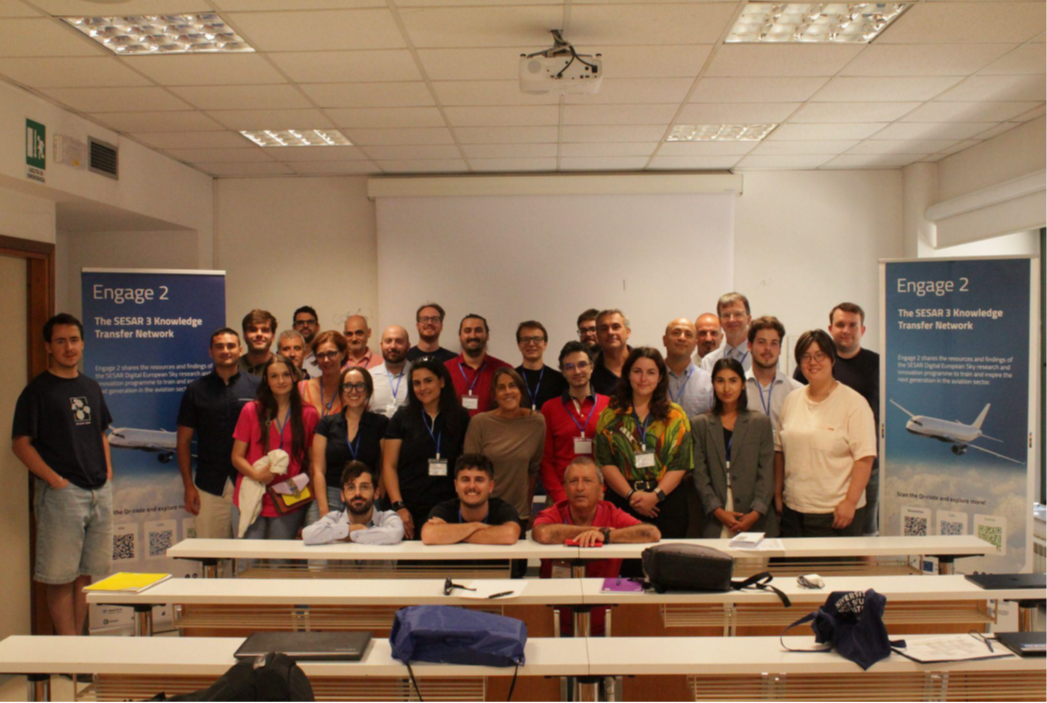
As aviation becomes increasingly digital and interconnected, how can air traffic management systems prepare for rare but potentially disruptive events? The ATM-RARE project recently explored this question with the next generation of aviation innovators at the SESAR Engage 2 KTN Summer School in Trieste, Italy.
During the summer school, the ATM-RARE consortium, represented by Collins Aerospace, delivered a presentation entitled “Securing the Skies: Next-Generation Cyber Resilience in Aviation R&D”, offering students a behind-the-scenes look at how European research is tackling emerging resilience challenges in aviation.
A central focus was the concept of high-impact, low-probability (HILP) events: rare and extreme occurrences that are difficult to predict but can have significant consequences for highly automated ATM systems. The project is exploring how systems can move beyond simply preventing disruptions towards identifying early warning signs, absorbing shocks, adapting to changing circumstances and recovering effectively.
To illustrate how this research can translate into practical applications, the consortium presented four operational scenarios being investigated by ATM-RARE: aircraft as a sensor, runway sequencing, airport power blackouts and severe clear-air turbulence. These use cases demonstrate how resilience approaches can help address potential disruptions across different aspects of aviation operations.
The exchange also extended beyond the presentation itself, with consortium members acting as PhD discussants, reviewing research by postgraduate students working on cyber resilience. The discussions provided an opportunity to share expertise, challenge emerging ideas and strengthen links between academic research and industrial innovation.
By engaging with the next generation of ATM researchers, ATM-RARE highlighted the importance of bringing research and industry closer together to help build a more resilient Digital European Sky.
More about the project
Read full blog
ATM-RARE is one of 49 projects recently launched under the Digital European Sky research and innovation programme. The project is exploratory research co-funded by the European Union under the Horizon Europe programme (Grant Agreement No. 101287690).