
Europe has no shortage of innovative ideas for modernising air traffic management. The challenge is turning those ideas into operational solutions that deliver real benefits across the European aviation network.
Europe has invested significantly in developing and testing new technologies designed to make air traffic management (ATM) safer, smarter and more efficient. To date, 139 SESAR Solutions have been delivered, with around 70 already in deployment, either through synchronised deployment across Europe or through local implementation. But turning promising research into operational solutions requires more than technological innovation. It also means ensuring that technologies can be standardised, industrialised and adopted across Europe's aviation network.
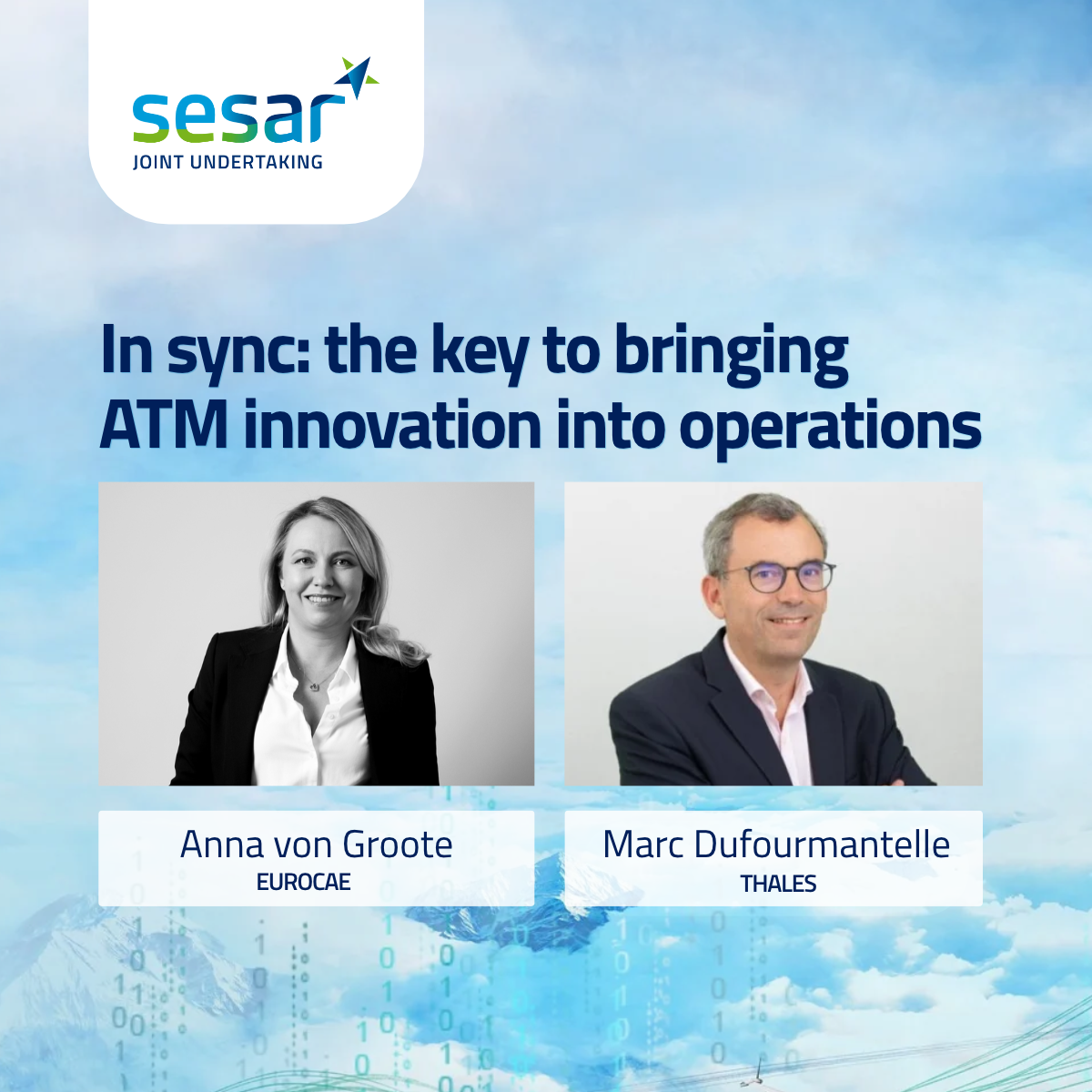
What does it take to bridge the gap between innovation and deployment? We spoke to two leaders from the SESAR JU membership: Anna von Groote, Director General of EUROCAE, the European organisation responsible for developing aviation industry standards, and Marc Dufourmantelle, Vice-President Strategy & Public Relations, Air Mobility Solutions at Thales, to explore how standardisation, collaboration and investment can help bring new ATM technologies into everyday operations.
Industrialisation starts with standardisation
Just because a technology has been successfully developed and validated doesn't mean it's ready to be installed and used across Europe's aviation network. Before that can happen, it must go through industrialisation – the process of turning a research solution into a product or service that can be manufactured, certified and deployed.
For Dufourmantelle, industrialisation is the critical missing link in Europe's ATM modernisation effort. “We clearly have innovation and we have deployments; what we are missing is industrialisation,” he says.
von Groote agrees “Research alone is not sufficient, we need to bring it into operations. We need to deploy it.”
A good place to start is standardisation. Standards establish common technical and operational requirements and help ensure that new ATM technologies work safely and effectively across different systems, organisations and national borders. Yet despite their importance, standards have traditionally been treated as something to address towards the end of a research project.
For von Groote, this started to change but needs to continue to be in the focus. “Standards are not the final administrative step, they are a critical enabler for turning research into reality,” she says. This is an approach that SESAR Joint Undertaking and EUROCAE have been working to get right over the years. This early collaboration helps identify standardisation needs and ensures that emerging solutions are developed with their eventual deployment in mind.
To illustrate the benefits of this approach, von Groote points to SESAR's work on remote tower technology.
As researchers worked on bringing visual representations of airfields into remote tower systems, EUROCAE began developing the necessary standards. As the technology evolved, so too did the standards, incorporating new functionalities as they were developed and validated. “This is really how it should be,” says von Groote. “The two processes should run in parallel, allowing us to evolve together.”
Creating the conditions for investment
Even when the technology is ready and the different stakeholders are working together, moving into operation requires investment. This is particularly from ANSPs responsible for implementing new ATM systems, which need the resources to introduce new ATM systems while maintaining existing services.
Large-scale demonstrators, like those run by the SESAR JU, can help bridge the gap between research and industrialisation. By bringing technologies into realistic operational environments, they allow stakeholders to see how solutions perform in practice, assess their viability and build confidence in their wider adoption. They also help demonstrate how different technologies can work together, providing valuable evidence to support the next steps towards implementation.
According to Dufourmantelle, this is an area where Common Project 2 (CP2) could make a difference. In October 2026, the SESAR JU submitted a proposal to the European Commission setting out possible content for a future CP2 regulation. This input includes measures aimed at strengthening the industrialisation phase, encouraging early adopters to work with manufacturers on the standardisation, certification and development of new ATM technologies. The Commission will now consider this proposal as it takes forward its work on the regulation.
But for these early adopters to lead the way, they need financial support. “ANSPs need budgets to work with industry on developing and implementing new air traffic control systems,” explained Dufourmantelle.
He also stresses the importance of public-private partnerships and a regulatory environment that supports innovation. These are particularly important given the scale and complexity of modernising Europe's ATM infrastructure, where bringing new technologies into operation requires coordinated investment from both public and private stakeholders.
For Dufourmantelle, the key is ensuring that industrialisation receives the same attention and support as research and deployment.
“Europe already has the industrial expertise, research capabilities and collaborative structures needed to modernise ATM, the challenge is making sure these assets work together to turn innovation into operational realities,” he says.
After all, developing innovative technologies is only the beginning.
Their real value comes when they're put to work.
Watch the full interviews